
Voices
December 4 [2025]
Urushi(Japanese lacquer)instrument crafting, music composition, performance, production…The multi-talented young artist, Genshun Yamanouchi
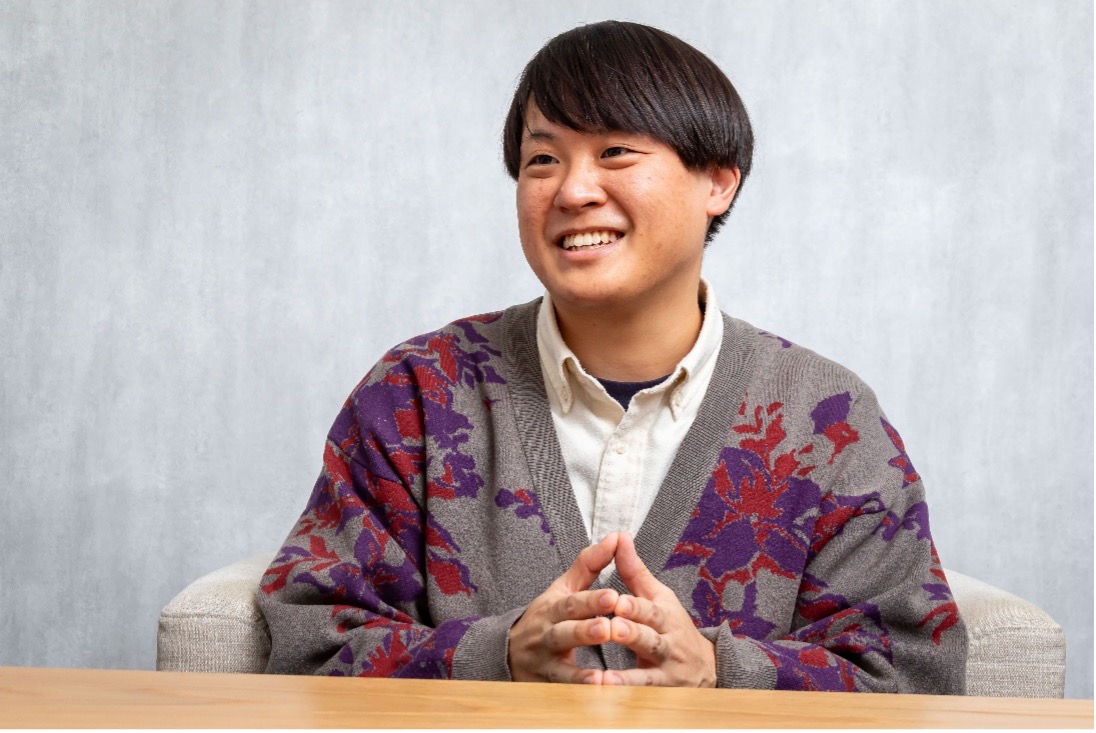
In the spring of 2025, VS. received a message. The sender was Genshun Yamanouchi. A graduate student at Kyoto City University of Arts, he creates and performs on Urushi(Japanese lacquer)instrument crafting, music composition, performance, production…The multi-talented young artist, Genshun Yamanouchi instruments, expressing a strong desire for an opportunity to exhibit and perform at VS. Further conversation revealed the extraordinary freshness and richness of his activities, the polish of his work, and above all, the immense passion bubbling forth. Recognizing this rare young talent, it was decided to hold a VS. presents concert on December 7th. We spoke with Mr. Yamanouchi just before the performance. This marks a first step toward a new stage, not only for Mr. Yamanouchi himself, but also for VS., which serves as a “cultural apparatus” for generating creativity.
From instrument making to work production
The “connections with people” at the source of his activities
――What led you to start making musical instruments, Mr. Yamanouchi?

I majored in crafts, but what really sparked my interest was wanting to stand out a little in a place where individuality thrives (laughs). I have always enjoyed working with wood, but music was also a big part of my life – I started playing acoustic guitar in elementary school and was in a band during art high school. That background made me think, “I can approach music from the perspective of structures,” and “I want to create everything myself, starting from the very mechanisms that produce sound.”
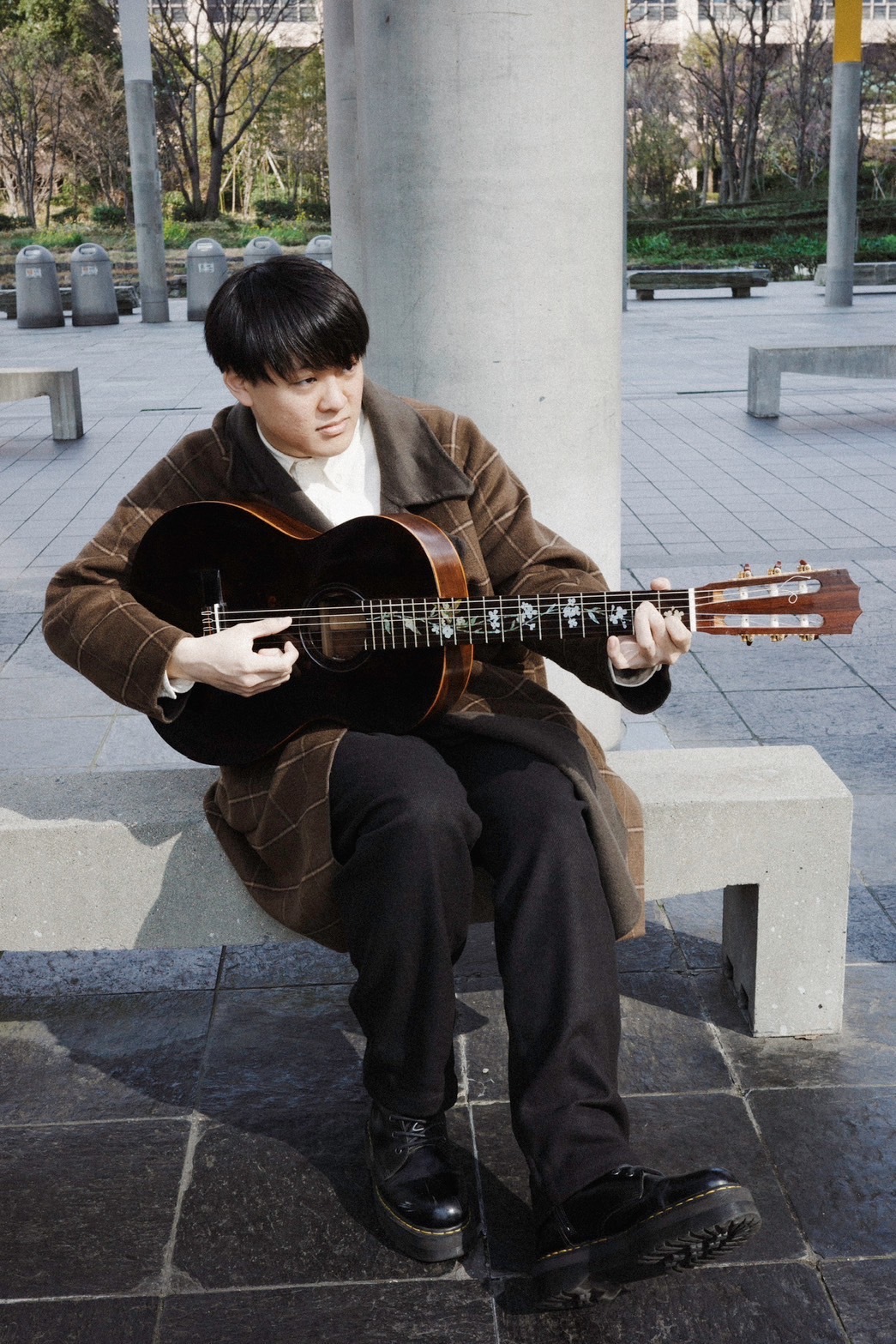
The first thing I made was a guitar. I started by finding a craftsman and assembling the guitar myself. I was drawn to the coolness of Mr. Kawamoto, the guitar maker, and I have been playing classical guitar ever since.
――I heard that you later began crafting instruments other than guitars. Could you tell me what inspired you to start and any challenges you faced during the process?
I built my marimba almost entirely by self-teaching. Mr. Kawamoto’s son found reference materials for me, which I used to create the blueprint. I built it piece by piece, had a marimba player I knew try it out, and repeated the adjustments many times.
Also, I am a fan of the artist Shuta Hasunuma, and I received cooperation from K-ta, the marimba player in the “Shuta Hasunuma Philharmonic Orchestra” led by Mr. Hasunuma. K-ta also participated in the recording.
I have also made a clavichord. It all started when Mr. Hasunuma suggested, “Why don’t you try making a clavichord?” Up until then, I had avoided keyboard instruments because they seemed too difficult. So first, I consulted with a professor in the piano department at my university. He introduced me to a craftsman named Mr. Akihiko Yamanobe, who taught me intensively and allowed me to stay with him while learning his craft. When I later showed the finished piece to Mr. Hasunuma, he was completely astonished, exclaiming, “You really made it!?” (laughs).
――Going forward, if musicians commission instruments, might you consider providing or selling them?
Previously, my work was self-contained, but recently I have been given such opportunities. However, Urushi instruments themselves – such as traditional Japanese instruments – have existed for a long time, so simply making instruments may not be particularly novel. I believe my uniqueness lies in crafting instruments myself, performing on them, and even composing music and producing ensembles.
――Mr. Yamanouchi, you incorporate not only acoustic instruments but also synthesizers in your music.
The idea came from a member of the Yamanouchi Philharmonic suggesting, “Wouldn’t it be more interesting to add a synthesizer? It might enhance the ambient feel.” Personally, I was quite attached to using only acoustic instruments, so I was a bit resistant at first. However, I realized that “incorporating others’ opinions” is also important, so I sought a compromise I could accept.
Although I call myself a composer, I actually can’t read or write sheet music. So, I input the sounds myself, then convert that MIDI data into notation. Using that score as a base, I consult with someone majoring in composition at university, making revisions together. Then, I discuss directly with the members to complete the piece.
――In some of your works, I find that the poetry is also quite striking.
The poetry is by Ms. Sayaka Takada, who handles the recitation. Our connection began on social media – I was posting about the marimba-making process online when Ms. Takada followed me. She was majoring in Intermedia Art at Tokyo University of the Arts and working on the “School Song Revival” project. I myself was interested in attempts to integrate music and history, so we deepened our exchange, and she came to participate as the poet and reciter.
I’ve considered adding vocals, but I ultimately wanted the focus to remain on the instruments’ sound. The balance feels best with the main melody played by the instruments, accompanied by occasional recitation.
――I feel that for you, both instrument-making and music production are built upon connections with people.
I truly feel the same way. Rather than doing everything alone, creating instruments and music while interacting with others allows things beyond my own capabilities to emerge. This opens up opportunities to embrace what once felt resistant and to try new things. There’s a fascinating sense of unexpected possibilities unfolding through that process.
Playing unknown melodies at VS. where fate converges
“VS. Yamanouchi Genshun: Omniazimuth”
――Could you tell us what prompted you to want to hold a concert at VS. this time?
First, the location near JR Osaka Station was a major draw. Plus, it is a building with design supervision by architect Tadao Ando – I absolutely wanted to hold a concert here! So, I reached out myself and was able to speak with the people at VS. Then I realized how many areas of overlap there were between VS.’s activities and my own.
For example, at VS., they have hosted events like Ryuichi Sakamoto’s exhibition “sakamotocommon OSAKA,” live performances by the respected Shuta Hasunuma, and Baschet sound sculpture. I myself provided a clavichord for the event “Ryuichi Sakamoto | Seeing Sound, Hearing Time” held at the Museum of Contemporary Art Tokyo last year, which also connected me to Mr. Hasunuma. The professor who has mentored me at university is a director of the Baschet Association, and my prior involvement with Baschet projects also felt like a shared connection.
――Please tell us about your enthusiasm for this concert and what points to highlights.
First, two guest performers will appear as the opening act, playing and singing using my instruments. Then, I have written two new pieces specifically for this concert. The piece titled “BIRTH” features the harpsichord as the main melody. While our parts throughout the entire performance are collaborations with visuals, “BIRTH” uses documentary footage by director Mimi Kobayashi to express the joy of birth.
Another new piece, “SPIRAL,” features a clavichord playing the main melody, with the same phrase repeating continuously. Both pieces were conceived with the acoustics of STUDIO A in mind, using a sparse number of notes. Please look forward to experiencing how the acoustic vibrations of the strings are amplified within that space.
――This performance will take place in STUDIO A, one of the most distinctive venues at VS., featuring a ceiling height of 15 meters.
The ‘omnidirectional’ in the event title refers to the many ways I engage with other artists -through face-to-face performance, having them play my instruments, or creating visuals in response to my compositions.
We’ll have both acoustic and electric instruments, plus drums and bass. In that unique acoustic space, creating an ensemble is probably more challenging for the PA engineer than it is for us. I’ve been working for quite some time with Mr. Shogo Yamane, who frequently handles PA for koto and historical instruments. Even I can’t quite imagine how it will turn out. But rather than anxiety, I feel more excitement and anticipation. We invite our audience to imagine the resonance of the sound, and we’ll welcome them with a performance that surpasses even their imagination!